Rebecca Reubens: Bamboo – Sustainability – Design
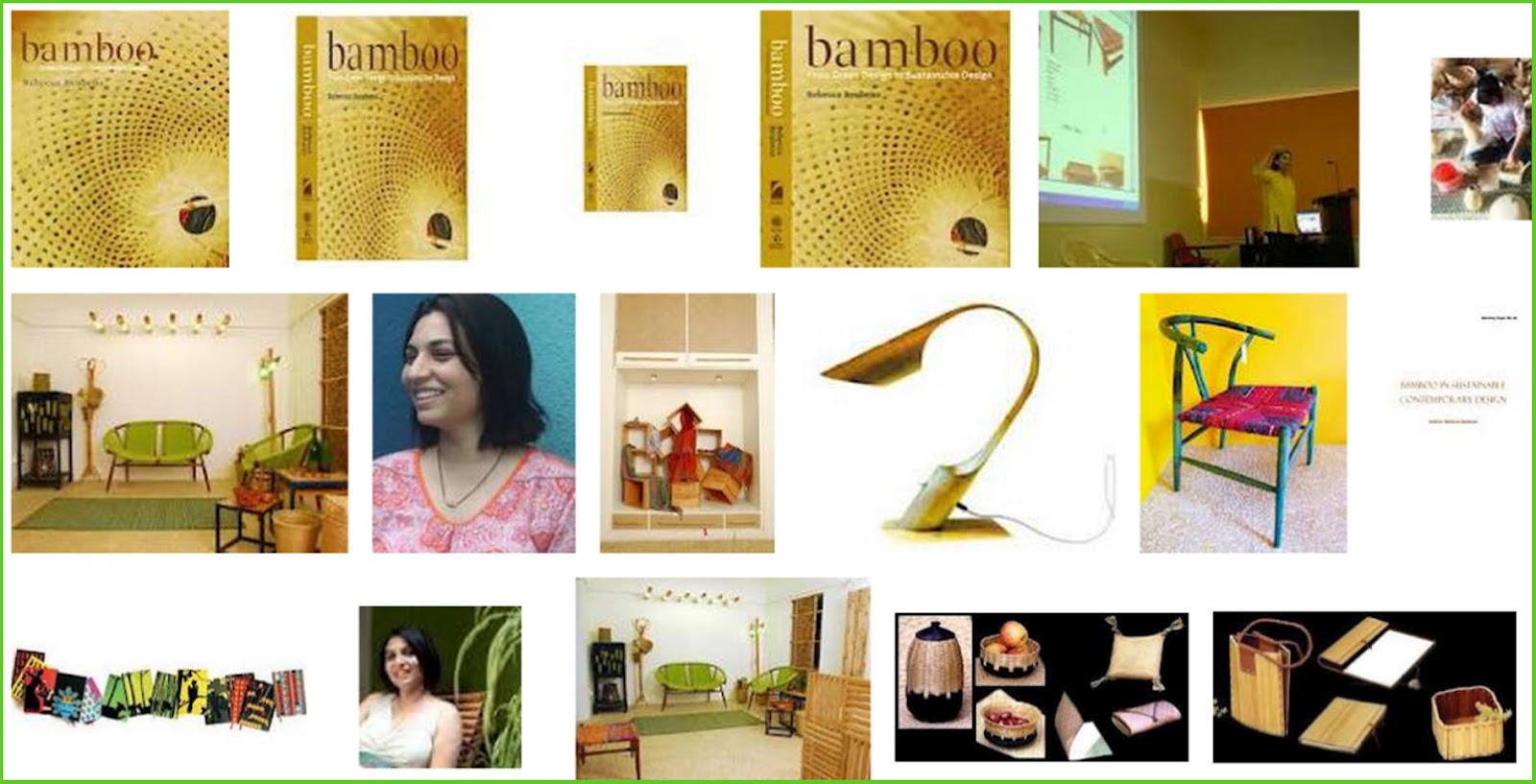
The book “Bamboo: From Green Design to Sustainable Design” by Rebecca Reubens is now on the market and available on Amazon, Flipkart and at stores in India and overseas. Today I got my hands on my own copy inscribed by Rebecca and it is a good feeling to see the seeds sown so many years ago blossom and grow into such a fine offering. Some time ago she asked me to write an Introduction for her book and my note is now part of that product offering as the "Preamble" which I have quoted below.
Preamble
Rebecca Reubens has asked me to write an Introduction for her new book that attempts to bridge three fields that I am deeply interested in and in which I too have been working for a very long time now. The three fields are Design, Bamboo and Sustainability, all of which are extremely complex in their own right and there is little real understanding of the issues and approaches within each of them in the modern world due to a paucity of published research here. Modern design has been around for some time having evolved from its roots in the industrial revolution but it has unfortunately become a form of consumerist expression by industry and the profession and the real human development angle is all but forgotten and we need to rediscover this aspect as a fresh approach. Bamboo is still quite unknown tomodern industry and the design profession although it is a grand old material of traditional societies across Asia and Latin America. Finally, Sustainability has arrived with a bang at the policy level since we are faced with the excesses of industry and governence that has caused both global warming and climate change as well as social unrest which is a product of our selfish ways, all needing a serious rethink and I am happy to see these three issues being addressed here in this book.
In the world of traditional societies in Asia, Africa and Latin America there exists a demonstrated deep understanding of all three subjects since these have been used in an evolutionary manner by local communities for many centuries. These continue to exist as a living culture in their rural communities and lifestyles even today but I must say that modern communication and changing aspirations is affecting these towards rapid extinction. Just as our plant and animal species are being depleted by massive modern exploitation of resources these pearls of traditional wisdom are being lost just as rapidly by human neglect. Here I must draw particular attention to the Apa Tani tribes of Arunachal Pradesh who have over many centuries of development in their niche valley in the Eastern Himalayas demonstrated a sustainable lifestyle that is based on the careful cultivation and utilisation of bamboo, timber and an integrated water management system for agriculture that is as yet an unknown value in modern life around the world.
Design, on the other hand, is a natural human activity that evolved with man over the ages but it has now has been relegated to the precincts of a professional marketing priesthood that manages the activity in the marketplace of our global economy. Design as it was deeply understood by traditional societies as a broad based human imaginative activity has been relegated to the back burner since we have chosen to follow the specialized path of science and the trained manager since they provide rational answers for everything and modern man and their society can only decide based on explicit knowledge while design in most cases is felt or tacit knowledge and is based on instincts that are better judged by sensitive interpretation rather than by the application of cold logic. This is why I felt compelled to set up my blog titled “Design for India” where I could debate the other dmensions of design that are much needed in India today.
Bamboo, has been nurtured by traditional societies across Asia and Latin America and its varied species provide a natural material that had wide spread use in thousands of traditional applications in many parts of Asia, Africa and Latin America where it was abundantly grown but with the arrival of industrial revolution and the spread of Western know-how the dominant materials of our economies started depending on minerals like stone, limestone and cement, metals like steel and copper, synthetics such as plastics and petrochemicals and some economic agricultural commodities such as cotton and jute. Bamboo was therefore neglected by the colonial leaders as the spread of technology and formalized knowledge also meant the reduction of local knowledge in materials that were already in wide and sophisticated use in Asia and Latin America, particularly bamboo which was considered the ‘poor mans timber’ while the emphasis and official attention of the Government in India shifted to timber and wood during the heydays of the British Raj.
Sustainability is the hallmark of most settled societies that evolved slowly over thousands of years and gradually built up their lessons of stable and predictable agriculture and lifestyles that were quite in sync with the beat of natures’ processes. However with the arrival of power assisted technologies and communication man could do a lot more and much faster and the race for the dominance of nature commenced in real earnest and each nation tried to outdo the other in their race for global dominance in economy, power and social well being, all measured by growth and growth alone. However, the destruction of pristine rain forests in search for minerals and material wealth and the release of toxic gasses into the atmosphere has had its natural consequences and we are on the threshold of rediscovering the concept of sustainability in the face of the threat of human extinction, a threat that is imminent, if corrective strategies are not adopted by the worlds citizens and their political leaders on a most urgent basis. Sustainability is then a call for a return to a steady-state economy that echoes nature in all its involved and intertwined processes.
This impending crisis places this particular manuscript at the centre of the debate where all three subjects can play a meaningful role and in trying to address and bridge these three difficult but critical fields that promise to bring long term benefits that can counter the problems of our uncontrolled developments of the past few hundred years. Design strategies will need to be explored and design itself will need to be understood and applied by political leadership across the world along with the subjects of science, technology and management and design at a deep level will play a huge role in the reversal of global warming and the move towards sustainability in the days ahead. Bamboo is the fastest growing plant material known to man and we will need to learn to use it in new and improved ways to supplement our vast needs for materials across many areas of application and much research would be needed to fill the gaps in our knowledge along with an urgent attempt to codify and garner the traditional wisdom that still exists across the bamboo culture zones of the world, particularly in Asia and Latin America. Sustainability too is a subject of current scientific and political interest and there is much that we need to understand about the symbiotic processes that live and work in nature and then be able to use this understanding back into our own ways of living and doing things in the future.
This manuscript, “Bamboo: From Green Design to Sustainable Design” by Rebecca Reubens stands as a brave attempt to bridge the huge gap and I am sure it will encourage others to follow in the much needed integrative research and design actions that is needed in the days ahead. Rebecca studied design at National Institute of Fashion Technology (NIFT) and then joined National Institute of Design (NID) in the Furniture Design discipline where I used to trach teach till I retired in 2010. She started her own journey into bamboo when she took on the subject as her Diploma Project as a student of Furniture Design at NID. We had a challenging project handy as part of the Bamboo & Cane Development Institute (BCDI)project that I was heading in 2001 and she has stayed with the subject and journeyed far as a member of the International Network of Bamboo & Rattan (INBAR) field team and now she has taken it on as her subject for her PhD Thesis at TU Delft in Design and Sustainability through the medium of Bamboo. She also went on to set up her own enterprise to work with local communities in Gujarat and from this to learn the significance of human effort at the grassroots using Design, Bamboo and Sustainability as her driving principles and to learn from this experience that which is not yet stated in any book so far, lessons from real life experiences from the field. All three much needed today and I wish her success.
Design Thinker and
Author of blog – www.DesignForIndia.com
12 March 2012
Unquote


