Hiển thị các bài đăng có nhãn wildlife. Hiển thị tất cả bài đăng

Thứ Năm, 6 tháng 9, 2012

Wildlife - For Jitka and Hanka

We recently held a large family reunion and were visited by distant relatives from the Czech Republic (Jitka & her daughter, Hanka). Afterwards, Jitka expressed disappointment that she did not encounter more wildlife while in Canada, expecting to see large animals in a more prominent fashion. Hanka even had to write a report about the plants and animals she saw in Canada, but had to leave out the animal portion. There must be a perception that if you come to Canada you will see wildlife roaming freely and abundantly when the reality is that encountering wildlife is an uncommon event that causes me to count myself lucky when it occurs. It is a special moment when I see a moose on a canoe trip.

Here is a list of some animals that are possible to see while paddling in this part of Canada (Saskatchewan). I've excluded birds, fish, rodents (except the biggest rodents) and other small critters from the list because the list would get far too long and complex. It is in approximately descending order with the animals I'm most likely to see at the top.

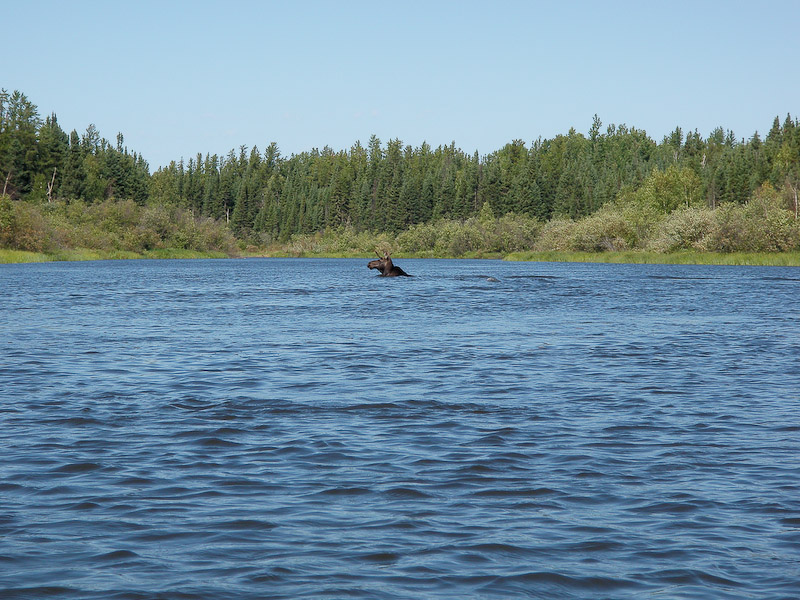
Moose swimming across the Montreal River. Photo by Rob Kunz.
  1. Beaver. I see beaver almost every time I paddle. Not only do I see them when paddling, we also hear the loud "kapuch" of their tail at night.
  2. Snowshoe Hare. Rabbit stew, anyone?
  3. Moose. The largest member of the deer family, I've seen these about 4 times now while paddling (twice in Prince Albert National Park, once on the Montreal River, once while paddling the South Saskatchewan River). In recent years moose have gotten much more common in the farming areas of southern Saskatchewan.
  4. Garter Snake. My kids have taken to searching the forest floor for garter snakes to catch.
  5. Fox.
  6. White Tailed Deer. Deer (white tail, then mule deer) would be at the top of the list except that this list has a paddling focus, and most of the northern places I paddle don't have many deer. The odds of seeing them when paddling the South Saskatchewan River are fairly high.
  7. River Otter. Otters are pretty cool to see. I've seen them in Prince Albert National Park and in 2010 we saw some on the Churchill River. In the winter I've seen their sliding tracks in the snow.
  8. Porcupine. Porcupine are all over, and in theory I should see lots of them, but I don't unless you count the dead ones on the side of the road. I know they are up in the trees and I often look for them, but only very rarely do I see them.
  9. Mink, Ermine, Weasel, Fisher. I'm lumping these members of the weasel family together, they are the smallest members of this list.
  10. Coyote. We often hear these at night, especially when paddling the South or North Saskatchewan Rivers.
  11. Raccoon. We have lots of them and I know they are around because I see their tracks in the mud, but I've never seen a raccoon on a paddling trip. I've seen hundreds of them dead at the side of the road.
  12. Woodchuck/Groundhog. We saw one in 2010 while canoeing on the Churchill River. My friend Mark claims they are quite common and he often sees them on the drive north. I never have.
  13. Black Bear. I've seen one once while paddling in BC, and many times driving. My most recdent bear encounter was a young animal that came to check out the messy smelly fish fry last month at the in-law's cabin at Candle Lake just as we were starting into supper. I chased it off making lots of noice and banging a 2x4 against the tree it scampered up into.
  14. Elk. What is it about elk and national parks? In Banff, Jasper and Waskesiu you will see them wandering the town streets. My odds of seeing them when paddling are not so high, but much better than some other animals.
  15. Lynx. I heard a lynx once while hiking, but have never seen one. The sound was very disturbing. More common than most people know, they are good at avoiding being seen.
  16. Wolf. Again, Prince Albert National Park is the likeliest place to see these elusive creatures, perhaps while on a snowshoe trip. The only wolf I have seen in the "wild" was walking down the middle of the road in PANP and was sick and perhaps starving.
  17. Cougar. There are more of these around than we would ever realise, they pass silently leaving little trace, and give a wide berth to humans.
  18. Buffalo. There are some places in Prince Albert National Park (and area) where it would be possible to see free-roaming wild buffalo (bison).
  19. Woodland Caribou. We have them, but the herds are small and during the paddling season tend to be farther north. They aren't coping well with human activities in the north.
  20. Badger. Wide ranging with large territories and rarely seen.
  21. Wolverine. Cousin to the badger and largest member of the weasel family. Wide ranging solitary animals with massive territories, these animals avoid humans and don't cope well with disturbances in their habitat.  
  22. Grizzly Bear. 120 years ago there were large herds of buffalo that roamed the prairies of USA and Canada, and many animals followed these herds. The Plains Grizzly was one of the animals that lived off of the buffalo and followed the massive herds. After settlers came the buffalo were hunted and removed from the prairies, and the animals that relied on those herds disappeared. The Grizzly Bears of the Alberta foothills are the last remnants of the Plains Grizzly population. It is still possible, but quite unlikely, to see Grizzly in the northernmost regions of our province, but it is likely a stray animal that wandered south from the Tundra rather than wandering east from the foothills. (On a related note, a Polar Bear was once seen swimming in the far northeast part of Saskatchewan. It was a young male that was starving.)
It is more common to see signs (tracks, scat) of these animals than it is to see the animals themselves. There are a few reasons why it is unlikely to see any of these animals very often. First, many of them are active at dawn and dusk, a time when it's hard to see wildlife and when we are not usually paddling. Most of our paddling is through areas of bush or forest which although it provides a home for the wildlife, it also provides them with ample cover, making seeing them very difficult as they don't stand around in the open. Also, hunting by local natives keeps the populations of the large game (i.e. moose) low in the regions that are close to native communities. Further, this is often a harsh country with a hard winter which means survival is often quite low. Many of these animals also require very large ranges - dozens to hundreds of square kilometers. The populations are not dense. Finally, the reason my family doesn't see as much wildlife as we might otherwise, relates to the fact that we have 2 young kids with us, and they aren't often quiet.

Finding signs of the animals is much easier than seeing the animals themselves. These are otter tracks on MacKay Lake in the snow on a very cold day. The otter runs a couple of steps, slides on it's belly, then pushes itself with it's hind feet while sliding on it's belly. 

The more common way to see moose lately, a recent photo by my father in the fields near the family farm.

Thứ Năm, 8 tháng 9, 2011

Photos From The Broken Islands Group

Last summer our family canoed on the west coast, paddling in to the Broken Islands Group, part of Pacific Rim National Park. It occurred to me this evening that I never wrote up a trip report or posted the photos from that trip. Here, at least, are some photos from this fantastic 5-day canoe trip in BC. The captions should help to explain some details.
 

Thứ Sáu, 4 tháng 12, 2009

Ray Mears, Northern Wilderness

I've been aware of Ray Mears for a while now, having heard of him described as Britain's version of Les Stroud, Survivorman. However, I'd never seen any of his videos and after having seen the abomination that is Bear Grylls, another person that gets compared to Stroud, I really didn't care to look much further. However, the Ray Mears documentaries for the BBC were recently recommended to me, and it was mentioned that an episode was filmed in nearby Prince Albert National Park. Well, today I found that video on YouTube (in 6 parts), which I believe is the first in a series.

I am embedding the video here, but if you have the bandwidth, watch it full screen in the highest quality. The full video is about 60 minutes long, but is broken up into 10 minutes segments for YouTube. To see all of the video clips in order, go to the playlist found here. The clips played automatically for me, one after another in order. The production and videography is excellent. The interest, information, and entertainment value are also very high, in my opinion. The focus, at least in this first episode, is not so much on skills or wilderness techniques described, but on the ecology of the boreal forest.


I watched the "Forgotten Forest" episode this afternoon (somewhat accidentally - I didn't mean to watch the whole thing). This evening I watched it again with my wife, at least the 2/3 until she fell asleep, it being past her bedtime. The Forgotten Forest episode was filmed in Prince Albert National Park (PANP), my familiar trekking and paddling grounds. I was able to recognise some of the places shown in the film, just this summer swimming and playing on the beach where he had the small fire with the jack pine cones in the film (I'm about 70% certain on his location). It is great that the park was shown in fall and winter, the seasons I like best in the park. I've been to Grey Owl's cabin on Ajawaan Lake about 6 or 7 times, by foot, snowshoe, canoe & kayak. This summer I brought my kids up to the cabin. It was also very interesting to see him putting into practice the use of the Black River sled, the Snowtrekker tent, and small wood stove. Also, the jacket Mears is wearing is not a parka as it may first appear, but an uninsulated shell cotton anorak, much like that made by Empire Canvas Works. A cotton shell would be breathable, shed the snow, and not tear or burn as readily as gore-tex or synthetic material shells (which work poorly in freezing temperatures).

It's interesting to learn a few more things about my own back yard from a Brit. Ray Mears conveys a great deal of respect and a sense of awe towards something that most folks around here take very much for granted.

The ecologist that is featured during this episode is J. David Henry. His cold-weather clothing looks like something from a MEC catalogue, circa 1986, but obviously it's still working for him after 20+ years. (As an aside, I wonder how much of their current product line will still be in use after another 20 or more years?) His mitts look very much like my MEC over-mitts, but in flashier colours. Henry co-authored a chapter in the book Endangered Spaces titled "Misunderstanding the Prairies." The biography of Henry in my copy of the book, published in 1989, describes Henry as a biology professor in Regina and as a key player in the revision of the National Parks Act and the establishment of Grasslands National Park.

The woman teaching the birch bark biting was Sally Milne a Cree elder from La Ronge. You can find out more about her here: http://www.virtualsk.com/current_issue/culture_and_spirit.html
Thứ Sáu, 24 tháng 10, 2008

Scrawny Wolf, Mangy Coyote or Ferrel Dog?

My wife & I spent the Thanksgiving weekend in and around Prince Albert National Park, staying at Elkridge Resort (but that's another story). On Sunday, while driving the scenic route south of Waskesiu on our way to the Spruce River Highlands hiking trail, we saw this sorry creature loping down the road.
I was certain at first that it was a wolf, albeit a young and scrawny one. Despite our approaching vehicle, it remained on the road, paying little heed to us as it casually trotted or walked down the center of the road. Occasionally it would stop to gaze around, or wander from one side of the road to the other before it continued it's meandering course.
We followed the animal in the car at a very slow pace. Even the passing of an oncoming vehicle completely failed to faze the animal. The closest we approached in the car was probably 20 feet.


Eventually, it wandered off into the bush, but still trotted along parallel with the car, just a few yards in from the ditch. After 100 yards or so through the bush it returned to the ditch where we shot a bit of video of the animal.


As I mentioned above, my immediate thought was that it was a wolf. The legs are long and it is lean, not like the typical pet dog. I thought it was too tall and large to be a coyote, but now I'm second-guessing myself and am not certain. Maybe it is a coyote after all, I don't think it's big enough to be an adult wolf. But then again, if the animal is starving or sick, and suffering mange (hence, the very thin coat) it would look much smaller than it's healthy relatives. I've never seen a coyote that light in colour and it's nose wasn't pointy like a coyote either. There was feces or mud stuck to it's rear end. Maybe it could be a ferrel dog? That would explain it's lack of concern over vehicles. Whatever it was, it doesn't appear healthy (though I'm not a vet nor a wildlife biologist; my real ability to determine animal health is limited to the lab). I still think sick young wolf seems the most likely.

I have a few buddies that will certainly know one way or the other. I'll direct them to his post and get their input.

Update 28/10/08 - I've heard back from 2 people that know better than I do, one who works for PANP, and another that is a wildlife biologist & veterinarian. Both agreed that I was correct, this is a wolf with mange. Dave in PANP says that a mangy wolf like this is not uncommon in the park. Bryan, a colleague in my lab, mentioned that when animals have mange, they can become so distracted by the itching from the mites that they are oblivious to everything around them, such as humans & traffic. Bryan also added that mange and canine distemper can be associated (hence the feces on the fur & the generally poor condition).
Posted by Picasa