Our family of four, including daughters aged 3 (nearly 4) and 7, was joined by my wife's cousin and her husband for a recent trip to
Prince Albert National Park. PANP is a great place to serve as an introduction to backcountry camping.


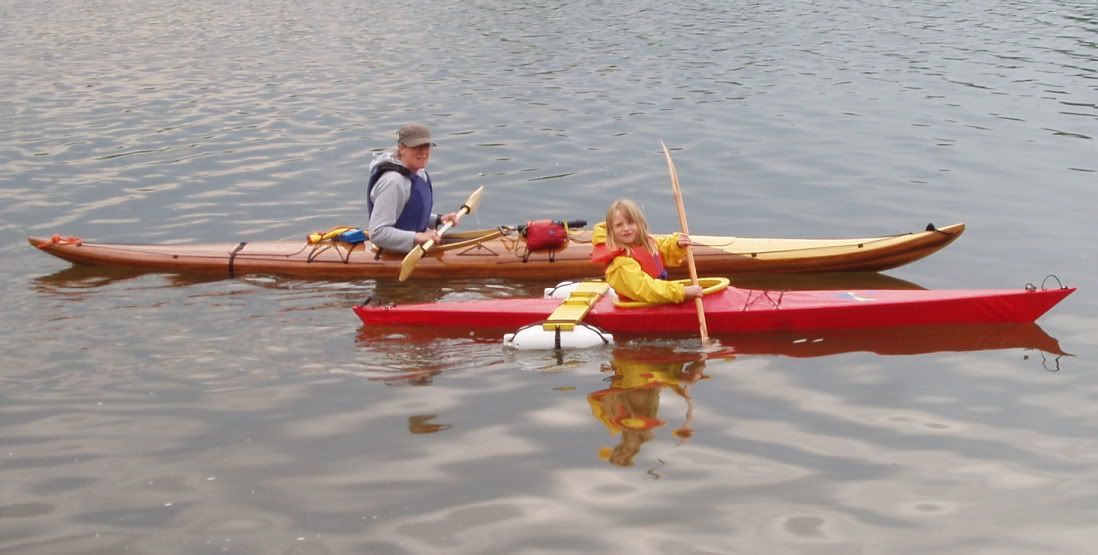
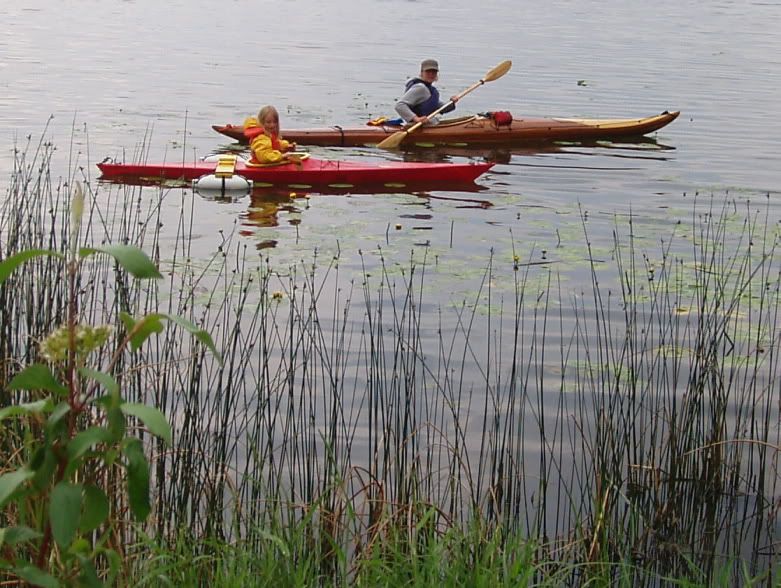
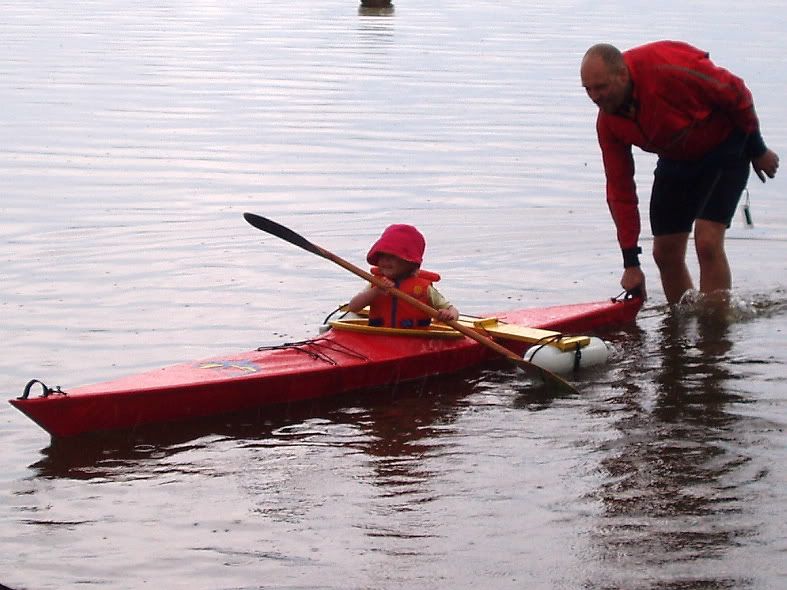
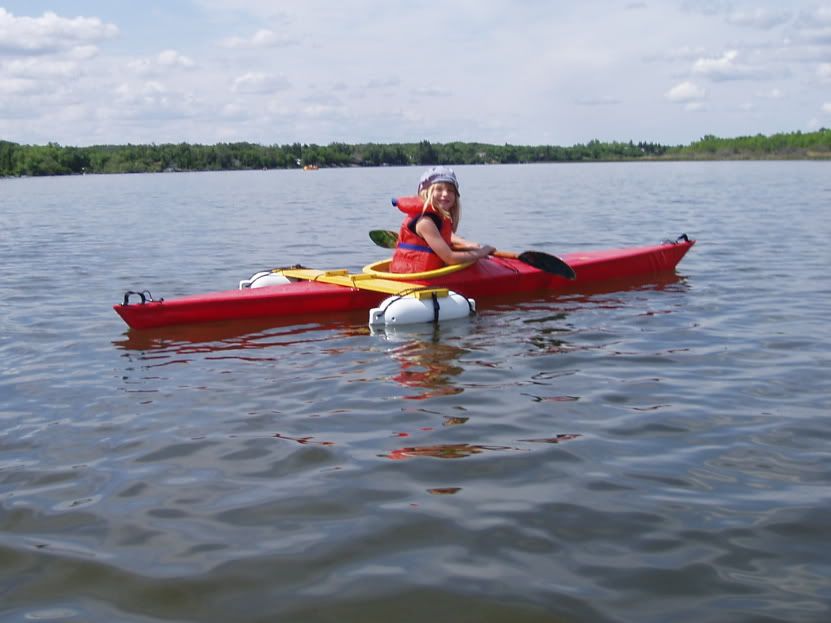
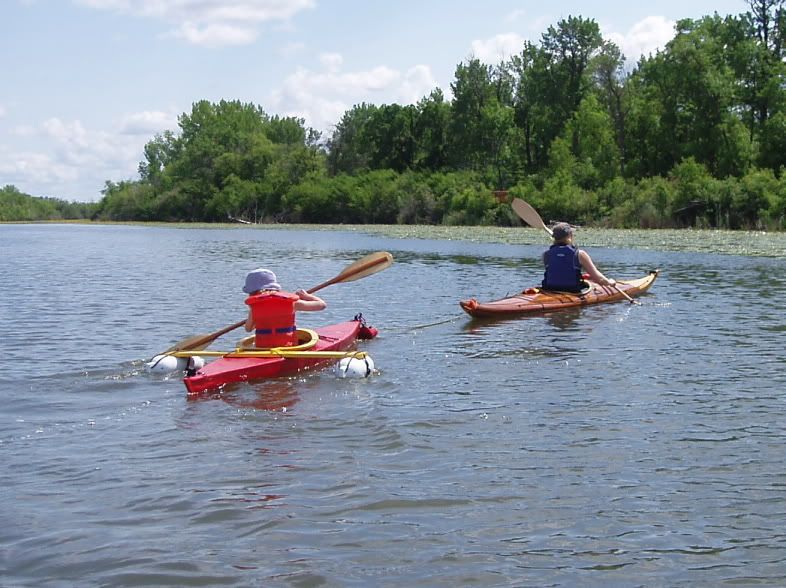
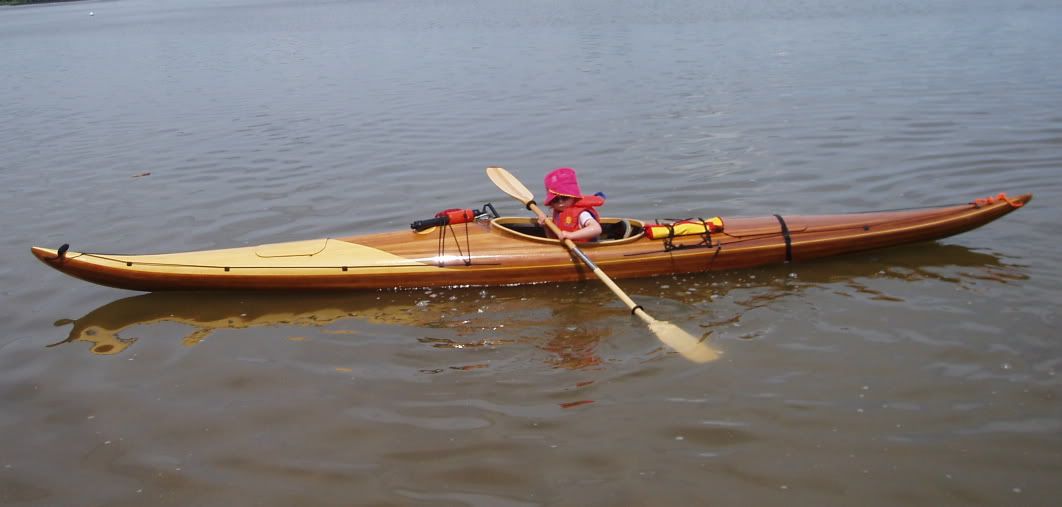
After paying our fees at the gate and registering at the office for camping and paying more fees (whew, camping in a National Park is expensive!), we drove to the put-in 30 km from Waskesiu at the Kingsmere River. The Kingsmere River is a lazy and beautiful creek that wanders between high banks and connects Kingsmere Lake with the north end of Waskesiu Lake. The current is moderate to slow, and one can paddle upstream without difficulty. Our fleet included my wife in her 17' cedar-strip kayak, my daughter in her 11' skin-on-frame kayak, Ashley & Ryan (cousin & cousin-in-law) in our 17' fibreglass Clipper Ranger, and me, Kaya the dog, and my younger daughter in our new 17.5' Royalex Swift Yukon with third seat. Although our daughters took turns in the kayak and sometimes paddled on their own, we typically towed them when we had anywhere to go.
We decided to camp at the Southend campsite on Kingsmere, a short paddle and long portage away from the put-in. The portage appears as a roller ramp just 400 m upstream from the boat launch. From the roller ramp, canoes and kayaks were loaded onto the rail carts used to negotiate the 1km long rail portage. There are two types of carts here. There is a small two-wheeled cart that worked well for one person to move one loaded canoe down the portage. There is also a large and very heavy four-wheeled cart capable of carrying a fishing boat and motor across the portage. This larger cart worked reasonably well for me to carry the three remaining boats, stacked one on top of the other with their loads. This large cart, painted green with John Deere stickers, is difficult for one person to push, especially on the uphill sections, however it is easier than portaging all of the boats and gear separately (and with two young kids we had a lot of gear). With two and three people pushing the large load is far less brutal and on downhill sections the trick can be to maintain control (there is a brake but I was pulling instead of pushing the lever).
With the portage out of the way, another 700m or so of river deposit you onto Kingsmere Lake very near the Southend campsite. When travelling through this reedy area, keep your eye open for Blue Herons where the lake meets the river. I have also seen moose along the river (south of the put-in). The southend campsite can handle maybe 7 groups (some large) at once, has a kitchen shelter with a wood stove (which would have been useful in miserable weather), two bear raised bear caches, and two outhouses. You need not paddle to reach Southend as there is a hiking trail that connects with the parking lot at the Kingsmere River put-in. The trail is an offshoot of the Grey Owl Trail and continues on to the nearby warden's cabin. This campsite was our home for 4 nights while we did day-trips in the area. There are also numerous other campsites in the region, along the east shore of the large lake, as well as in the connected smaller lakes of the nearby Bagwa Route.
The south end of Kingsmere Lake near the campground is very shallow and sandy so was a good place for the kids to play in the water and to mess around in the boats. The beach itself is mostly rocky or weedy in this spot, so on one of our days we paddled over to a nearby sandy beach so the kids could play in the sand. Sand is one thing you will find a lot of on Kingsmere Lake, we found it in our tent, in my binoculars, in my coffee, in our sandwiches, in our beer, and more.

Our first full day on Kingsmere was very calm, so we decided to take advantage of it and head out for a paddle on the large lake. We had the destination of Grey Owl's cabin in mind, but knew that everything would have to work out perfectly to achieve that goal and make it back safely. The lake is 11 km long and about 7km wide so it is large enough to get some good waves which tend to pile up on the shallow east side. We brought enough food and stuff with us in case we had to wait out any wind. Travelling with just the two canoes we headed out northward across the lake, more or less following the eastern shore. Our intention was to "play it by ear", only going as far as weather, kids, and our resolve allowed. Making good time despite playing with my new GPS and having to turn around to retrieve poly-pocket hair (a kid's toy) which tragically fell into the lake, we lunched at the Sandy Bay campground where the mosquitoes soon found us. After lunch we continued on to the north end of the lake and began the 3.2 km hike into Grey Owl's cabin, tormented the whole way by the swarms of mosquitoes. It's a nice walk if you can enjoy it. Unfortunately, travelling with the 3-year old and the mosquitoes made this trek somewhat less enjoyable than it could have been. In retrospect, I should have portaged a canoe 600m into Ajawaan Lake and paddled to the cabin (less walking for the kids, fewer mosquitoes). As a side note, this cabin was under threat of being lost to fire earlier in the season when forest fires were encroaching. Since then rain has ensued and hardly a fire has burned in the entire province for some weeks now. At the cabin, we signed the guest book and browsed through, finding the names of friends that have been there earlier in the season. The fair weather continued in our favour and we returned under continued calm conditions. The weather was mostly overcast this day and the obscured sun worked to our favour since it meant we were not fried to a crisp. An interesting aspect of paddling on Kingsmere is the remarkably clear water allowing you to watch the lake bottom while suspended twenty feet above. By the end of the day, we had paddled 25 km and hiked 6.5 km, not bad with kids and novice paddlers along.
Our next day was another gorgeous one, calm and sunny. It was spent playing on the sandy beach, in the water, or reading while drifting in a canoe (away from horseflies and mosquitoes).

On our fourth day we decided to take a tour through the Bagwa Route. Again travelling with only the two canoes, we enjoyed calm weather on Kingsmere Lake. After lunch and an hour or so relaxing and playing on a beach near Pease Point, we round the point to face head winds out of the southwest. Those winds made us work a little harder through the channel and gave us some waves to deal with on Bagwa Lake. We have seen moose before in the weedy channel to Bagwa Lake and our hopes were high for seeing the large mammals but we were not so lucky. We did see pelicans on Lily Lake. The wind blew us down the small lakes of Lily & Claire. The portages between those lakes are very swampy at their ends (as has been the case for many years) and especially the Claire Lake end of the Claire-Kingsmere portage. Portaging with small kids can be no fun, especially when the mosquitoes are horrendous. Once back onto Kingsmere Lake, the wind had diminished again (we were in the lee, but the wind had really dropped away) and our short paddle back to the Southend campsite was very beautiful. All told, it was a 20km day with two portages.
Our fifth day was yet another gorgeous weather and the temperature had climbed to the mid-twenties. We packed up and made our way back to the put-in (with the girls fighting over whose turn it was to paddle the kid's kayak). After lunch and ice-cream in Waskesiu and playing at the beach-front playground, we headed out on the highway and made our way home after nearly two weeks away.
Prince Albert National Park provides a family-friendly and novice-friendly camping experience. You are never far from help (with the exception of the Bladebone Canoe Route). Wind and waves can be a serious issue that paddlers need to be aware of and prepared for, but there are routes that can minimize this. We were lucky to have the weather we did. Despite that we did not see any large wildlife, the opportunity to see moose and other animals is greater in PANP than most areas I paddle (where moose represent many meals so are hunted by the natives for food). Except for their muddy ends, the portage trails are generally in good shape and well maintained. There is much to see and do, and there are some destinations of historical interest (Grey Owl's Cabin). Although we opted to head to Kingsmere this time out, we have also gone to Crean Kitchen campsite on Crean Lake. The Crean Kitchen campground is smaller than Southend but provides similar amenities including a shelter with wood stove. Crean Lake is larger and more open to wind than Kingsmere so can be a difficult place for open canoes, but the Hanging Heart Lakes should provide no difficulty for most. Sand is even more abundant on Crean than at Kingsmere. Canoes & kayaks can be rented in PANP from the Waskesiu marina or the Hanging Heart Lakes Marina.
And now for the pictures. (I've been having trouble with the pictures disappearing, just in case they do, here is a link to the Picasa Album where they are supposed to be stored.)
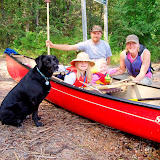
Here we are ready to launch into the Kingsmere River:
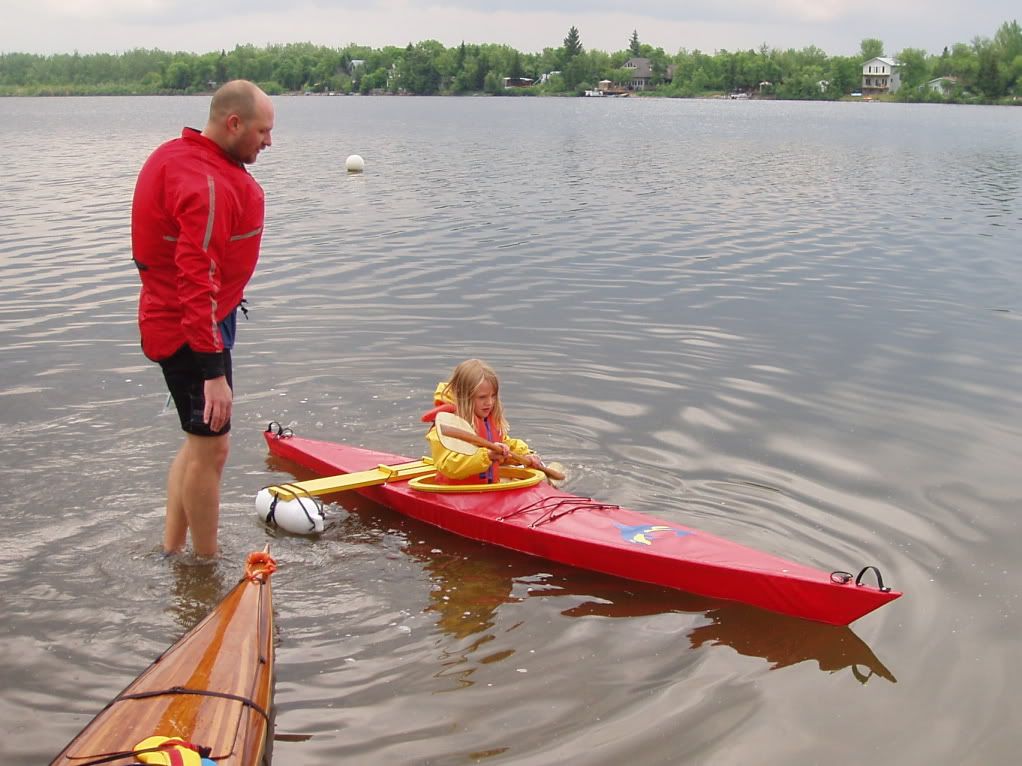
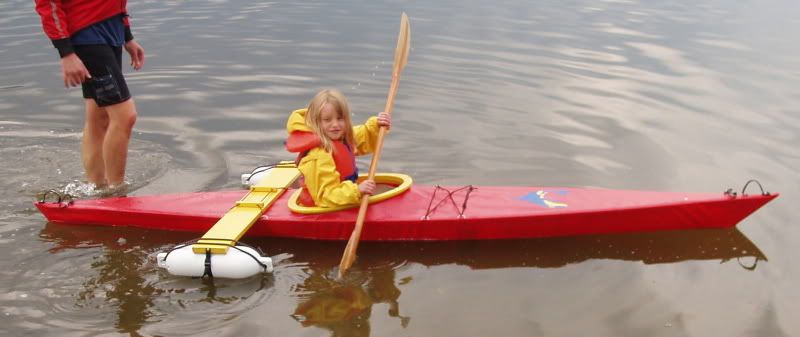
My daughter paddled her own kayak.
Four hundred metres later we arrive at the roller-ramp which raises the boats enough to allow them to easily slide onto the portage carts.
A bridge spans the river here connecting the portage trail with the trail to the parking lot (to the South) and Grey Owl's cabin (to the North).
This sign was posted near the portage:
Later that evening we were treated to a very nice sunset at the Southend campsite.
During our paddle to Grey Owl's cabin the girls played in the canoe, making use of the centre seat. When unloaded, the kids used that seat as a table more often than as a seat.
Lunch on a beach up the East side of Kingsmere Lake:
Once at the North end of the lake, we set off on the 3.2km trail to Grey Owl's cabin:
In this photo you can see the sprinkler and hose atop the cabin which were used (or were ready to be used) in June to prevent the cabin from burning in forest fires which threatened the area.
Grey Owl (Archie Belaney) & Annahaero's graves are also here, atop the nearby hill.
Signing the guest book:
Yours truly on the return across Kingsmere Lake:
Did I mentioned we had fair weather? We were very lucky, the wind can come up on short notice and paddlers must be prepared to deal with it. Don't get caught a very long way from shore unawares, especially with kids along.
Back at camp, we were joined by some good friends who we had wanted to trip with for a while now. We are not put off by their 2-dimensional personalities.
Playing in the shallow, clear & warm water at our campsite:
Playing ball is a bit of an unusual activity for us when paddling, but this campsite with a large open area can accommodate it.
While the kids played ball, I mixed up some Caesars.

Before setting off for the day of paddling, we took the opportunity to snap a family photo.
Another beach, this one up the West side near Pease Point:
Along the Bagwa Route there are a few reedy places. I think this is probably connecting Bagwa and Lily Lakes:
A couple days later, back at the rail portage on our way home:
Happy but mosquito-bitten: