Thứ Sáu, 10 tháng 12, 2010

Checking out the Chicago Harbor Lock repair

 The Chicago Harbor Lock is a monumental structure. Designed and built in 1936 to 1938, it was part of the remarkable engineering feat that reverse the Chicago River so that the city's sewage would flow away from Lake Michigan, not into it. These days, the lock opens and closes for 40,000 ships per years--commercial vessels, tour boats, pleasure crafts and kayaks--according to the US Army Corps of Engineers, which operates it.
   Or rather, it did until it was closed on November 1 so that its aging gates and hydraulics could be replaced.

McHugh was awarded the nearly $15 million contract to repair the Chicago Harbor Lock.
   We've paddled through the locks many times, so we couldn't resist the opportunity to check out how the job was going. Everything was on a superhuman scale.

Two of the four new structural steel sector gate leafs.
Still life with construction equipment and skyscrapers.
   The project is due to be completed by Tax Day 2011, which seems appropriate for a taxpayer-funded project. Between now and then, we'll check on its progress.

Thứ Tư, 8 tháng 12, 2010

What A Winning Week

The last seven days have been pretty lucky for me.  It started last Wednesday when I was listening to CFCR 90.5 while at work.  They mentioned on air to call in for the chance to win a pair of tickets to Sundog, a local craft fair.  I got through first and won the tickets (enjoyed by my wife and a friend).  Then, the same day, I received word that I had won a Littlbug Sr. wood and alcohol burning camp stove courtesy of a contest being presented by Littlbug Enterprises and Wintertrekking.com.  Yet a third lucky stroke that day occurred when I received an email from someone I've never met or heard of, informing me that I had been selected as the recipient of a $14 million inheritance.  Following that stunning windfall there was a lull of several days, but today I learned that my entry into the Badger Paddles High Water Mark contest was also a winner.  There will soon be coming my way a new paddle & paddle sock courtesy of Badger Paddles, and a $50 gift certificate from Algonquin Outfitters!

Wow, maybe I should go buy a lottery ticket or something, but I don't want to push it.  Besides, I've got that $14 million coming my way - I sent them all my credit card and banking info and am now just waiting for the cash to be deposited.

I'm really looking forward to trying out the Littlbug stove to see how it performs for me.  Maybe I can reduce my reliance on white gas and my MSR stove, burning small branches and twigs instead.  I also now get the fun exercise of deciding on what paddle to select from Badger.  I think perhaps the 'Tripper', or maybe the 'Badger Tail' or the 'Badger Paw'.  Any of those in an oiled walnut or cherry would be nice indeed.  And, what to get with the gift card?  I will have to phone Algonquin Outfitters to find out what my options are with that one, but at the moment I'm inclined to put it toward a new pot set if it's available for me.

Oh, and before I forget, go here to see the blog post which served as my entry into the Badger contest!  It was a fun way to enter a contest and gave me a chance to write about myself in a way that I wouldn't normally.  I have to give credit to Rob & Jay, because I think the photo of Rod golfing and the photo of me soaked after a capsize may have been what tipped the scales in my favour.  Maybe I'll let them cook me supper on my new stove. ;)

Now that's an icebreaker

   You know that uncomfortable feeling when you walk into a room and you aren't really sure whom to talk to or what to say? What you need is the USCGC Mackinaw, designed to ram through 32 inches of solid ice or ten feet of brash ice, and to fully penetrate a ten-foot pressure ridge in less than half an hour.
   Or maybe you don't need that, but the Coast Guard does, and it's mighty proud of this five-year-old vessel, which was docked next to Chicago's Navy Pier this morning, after distributing 1,200 Christmas trees to low-income families and retrieving buoys for the winter.

The USCGC Mackinaw.
   This is a luxury liner of a Coast Guard vessel. It boasts a 3133-square-foot heated buoy deck as well as two-person staterooms for its 55 crew members. And it has "multi-mission capabilities," meaning it can be used for search-and-rescue, buoy-tending, ice-breaking and even oil spill containment, as well as continuing the nearly 100-year-old "Christmas Ship" mission.


   Now there's a conversation starter!

Thứ Ba, 7 tháng 12, 2010

Project Vasari – hosted nested profiles

image


There will be times where you want to use a profile to create a swept form; this was reasonably easy to do pre Revit 2010, but the CDE has caused some confusion. So I am going to briefly describe how to use a mass family as a profile and then load this into another mass family and then host the profile to create a swept form or a simple extrusion using the nested profile. This is the start of multi stage tutorial and although I am undertaking this in Vasari the technique works just as well in full Revit's massing environment..

In Vasari start a new project. Next set one of the vertical workplanes to be your current workplane to draw on.

image

Next using a model line, draw a line on that current workplane.

image

After drawing the model line, choose the point tool and host a point on the model line. You will notice that the line will snap to the line and once hosted, you can drag the point back and forth along the line.

image

Next do a crossing selection to pick up the hosted pointed. We need to change the “show reference plane” parameter settings of the point from “when selected” to “Always”

image.

Ok, with this part completed, start a new mass.rfa and choose metric mass.rfa or imperial mass.rfa.

image

You will now draw a simple closed profile on reference level 1, using model lines, as indicated in the image below.

image

Save the family and then load this into your already open project with a line and hosted point.Having loaded the family into your project you will discover your profile will be attached to your mouse pointer. We now need to get the profile on the workplane of the hosted point.

image

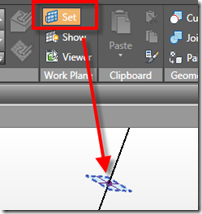
To do this, choose set work plane and pick the workplane of the hosted point. The profile will then flip around so that it is in the same orientation as the hosted pointed.
image

Place the profile on the hosted points as indicated in the image below.

image

Once you have placed the profile, select the model line and the profile you just placed.

image

Then choose “create from” the Ribbon, this will sweep the profile along the path.

image


With this basic knowledge you can start to get clever with your nested profiles. In this example I have a combination of profiles with different sizes.

image

In the next part of this tutorial I will show you how to combine this technique with the use of cut and join geometry to create a complex geometric form.

Autodesk Sketchbook Mobile – Android

 android-wallpaper5_1024x768

Are you an Android user? If so, be sure to download Autodesk SketchBook Mobile now available for Andriod as well as Iphone and Ipad. You will find the Android version on the Android market place.

Thứ Hai, 6 tháng 12, 2010

AU2010 – very quick summary

So I’m back to work after a week of BIM and AU overload, still a little jet lagged, but overall just about back in the land of the living. So what was it like you may ask? Hmmmmm well there where some highlights and some lowlights. Be sure to read William over at UnderNDA’s blog article on his Top 5 lists . I’d say this was pretty much close to my view on the event.

IMG_0130

Trends wise, everybody seemed to tweet, cloud computing has moved on to infinite computing and every other person had an ipad. On Tuesday morning, just after the keynote speak James Van and I did a class entitled Advanced Techniques for Curtain Walls and Panels. It was a 60 minute class, I have to say it was the fastest 60 minutes I have ever seen. As soon as we had started, we seem to have finished. Feedback wise, it was mixed, mostly people complained about the time,  but I have to say this is not exactly our fault. We where trying to cram in 120 minutes of material into 60 minutes. Lets hope next year Autodesk listen to the feedback and go back to the traditional 90 minute format. Still the funniest thing was reading the feedback, it was very random…..quotes like….

“Although advanced class, it was more than I expected.”

“seemed very rushed with 1 hour. The flew through all the material.”

“Super!”

“Presenters were badly organized.”

“It was good, but needed more content. In the time allowed, that is all that could be done.”

“Although advanced class, it was more than I expected.”

“seemed very rushed with 1 hour. The flew through all the material.”

“Super!”

“one of the speakers was bit hard to understand, the other was very clear. there was not enough time to cover the subject matter well so the overall experience was not as good as it could have been”


Overall we have ended up with a score of 4.388 out of 5, so I don’t think we were that bad!

IMG_0128

The bunny in the headlights look! This was 15 minutes before our class.

On the Wednesday I helped out Zach Kronz and Robert Manna with there Au Bon Panel Baking Your Own Adaptive Components and Panels labs class. This class got over subscribed so they had to run two, one at 8am and the second at 3pm. I would say the earlier class was probably more successful, but in both cases it was great fun and felt just like my day job running around and assisting people. Feedback again was very positive 4.646% and 4.765% respectively.

On Thursday I sat in on Phil Reads Zen of Void session. Back to some old school use of void in families. As usual, the class was presented in Phil’s polished yet sharp tongued style. Good to see he hasn’t lost of any of his passion and charm for the Revit technology. All the noise was about Phil's next career steps; I am sure you will start to hear more news over at arch+tech in the not to distant future! Certainly keep your eyes pealed as Phil seemed pretty stoked about his new career direction.

Thursday evening, Jim Balding organised an old timers Revit get together, which was great. More Revit geeks around one table than you can shake a stick at! I sat next to Steve Stafford who explained the AUGI forums wows! What a nightmare that is; the story behind this mess would make an amazing novel, its that messy!

IMG_0231

So that's it folks, AU2010 in a few simple lines. Was it a great one? maybe not, but from a social stand point it was invaluable. Next year AU2011 is back at the Venetian, I do hope that normal services will be resumed. Until then…….

Chủ Nhật, 5 tháng 12, 2010

Whitewater kayak class is in session

John Karch explaining whitewater basics to a pool full of students.
   This is week nine of the first of two 10-week whitewater kayaking courses offered by the Chicago Whitewater Association in the West Cook YMCA swimming pool. After the winter and spring sessions, the club offers a series of beginner trips on increasingly challenging local rivers. It's a wonderful way to learn to paddle.
   This is our spawning ground. We started learning to paddle here eight years ago. We were awestruck by the skill and generosity of our instructors, who volunteered their Sunday evenings teaching us to paddle and roll and let us borrow their boats and gear.
A few months later, they were out on their first river trips.

Culminating in a trip to Wisconsin's Wolf and Peshtigo Rivers.

  This year, we are the lead instructors at the West Cook Y. (Full disclosure: We're substituting for our our whitewater mentor, John Karch, who isn't available every Sunday this year but whom we expect to take the course back from us when he can.) It only took us nine weeks to realize that we could post our handouts on our blog, saving paper and ink and making the material more widely available.
   So that's what we're doing here. Below you will find handouts on hypothermia, safe river kayaking, gear checklists and more.
Hypothermia - from the Wilderness Medical Associates Field Guide.
The American Canoe Association "Paddler's Checklist."
The ACA's Guidelines for river paddling.
   For those who want to assess how well their skills align with river classifications, the ACA offers these skill assessments:
  We just created a resource list for our students. We'll post it here soon.